2026 Teacher Training for Certification Program Participants will be December 5!


The Golandsky Institute is the world’s leading center for the study, teaching, and advancement of the Taubman Approach through lessons, teacher certification, streaming education, events, and a global community of expert faculty.

The Golandsky Institute’s highly trained and certified teachers offer lessons in-person and online. Find the teacher best suited for your needs, based on a multitude of criteria including spoken language, location, and level.
Whether you want to improve technique, address symptoms such as tension, pain, or limitations, or wanting to gain pedagogical skills, The Golandsky Institute offers a multitude of programs and resources to guide your path.
The Golandsky Institute understands the power of having the right knowledge, and through our podcast, free resources, sample materials, and other available channels, we open the door to demystifying the Taubman Approach.
“Edna Golandsky is a consummate expert of piano technique and musical artistry. The depth of her analytical ability surpasses anything I have encountered.”
Ilya Itin
Concert Pianist
“The underpinnings of the Taubman technique rest on remarkably simple but, to my mind, highly sound and rational applications of a thorough understanding of anatomy and neuromuscular physiology.”
H. Franklin Bunn, MD
Professor, Medicine, Brigham and Women's Hospital and Harvard Medical School
“Before I met Edna I always had to warm up. Now I can sit at the piano and just go. I never get uncomfortable or tired.”
Danilo Pérez
Jazz Pianist and Composer
“It’s difficult to overemphasize the joy that I have experienced in discovering the Golandsky Institute after more than 50 years of serious dedication to the piano. ... As a physician, it is clear that this approach emphasizes the soundest of principles related to movement, and with proper movement, musical expressivity can be expanded to its optimal potential.”
Stanley G. Rockson, MD
Professor of Medicine at Stanford University School of Medicine
“The Golandsky Institute is an important pedagogical institution not just for the thoroughness with which it deals with technical concerns at the piano but also for the emphasis it places on the music first.”
Bill Charlap
Jazz Pianist
“The Taubman approach goes beyond mere injury recovery and prevention: it provides the framework for the development of musical virtuosity and provides a clear path for achieving it.”
Aaron Berkowitz, MD, PhD, FAAN
Professor of Clinical Neurology, University of California San Francisco
“Because of Edna and the Taubman Approach, my sound and technique have developed beyond what I could ever imagine.”
Sylvie Courvoisier
Composer, Pianist, Improviser and Bandleader
“I don’t know of any other Approach that addresses the problem of pianists’ pain and injuries like the Taubman Approach does. This is an Approach that goes to the root of the matter: the problem movements that cause the injury.”
Karin Boisvert, MD
Family Physician, Quebec
“I was profoundly impressed by Edna Golandsky’s deep understanding of piano technique. She is the only person I have ever met who was actually able to explain to me what I was doing naturally at the keyboard.”
Francesco Libetta
Pianist, Composer, Writer and Conductor
“Thank you very much for all the work the [Golandsky] Institute is doing to bring to pianists around the world these marvelous concepts about piano technique.”
Alessandro d’Episcopo
Jazz Pianist
Become a Certified Teacher of the Taubman Approach
Structured mentorship, supervised teaching, workshops, and progressive certification levels from Instructor to Master Teacher.
Study Anywhere, Anytime
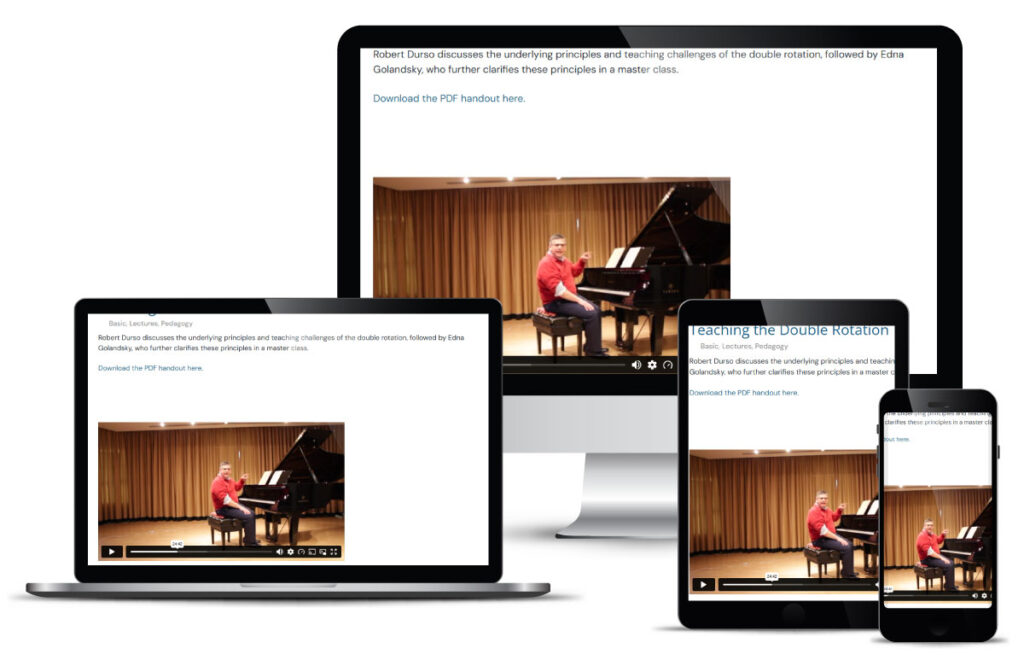
Access lectures, master classes, demonstrations, and educational content from leading experts.
Conversations with the Leaders and Teachers of the Work
Learn Live Throughout the Year
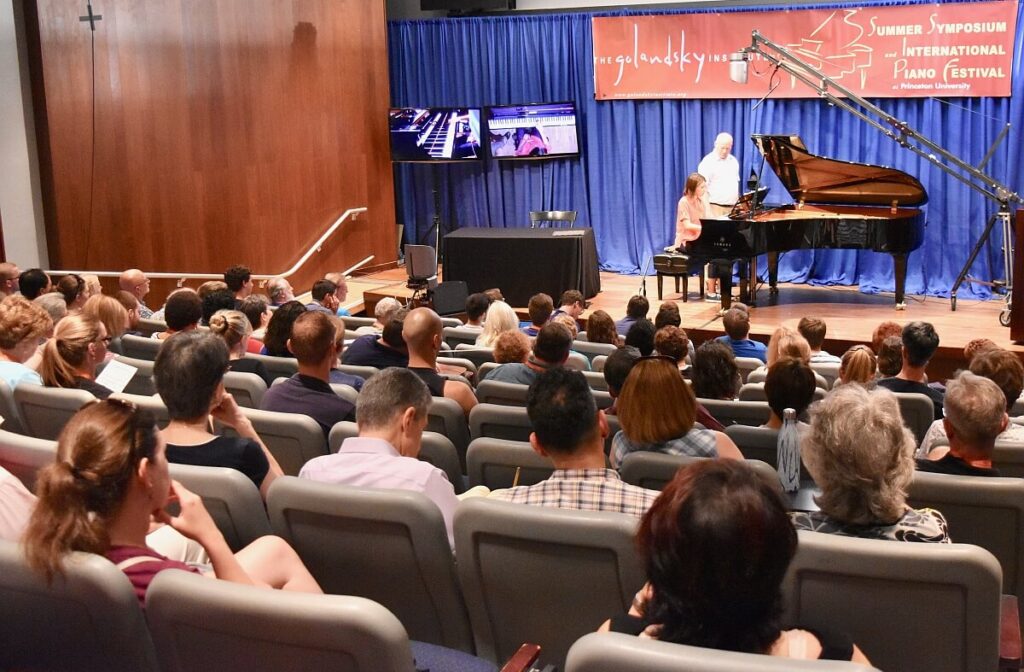
Workshops, teacher trainings, master classes, and the annual Summer Symposium bring musicians together from around the world.
Learn from Certified Teachers Worldwide
Study online or in person in multiple languages with faculty and certified teachers across North America, Europe, Asia, and Australia.
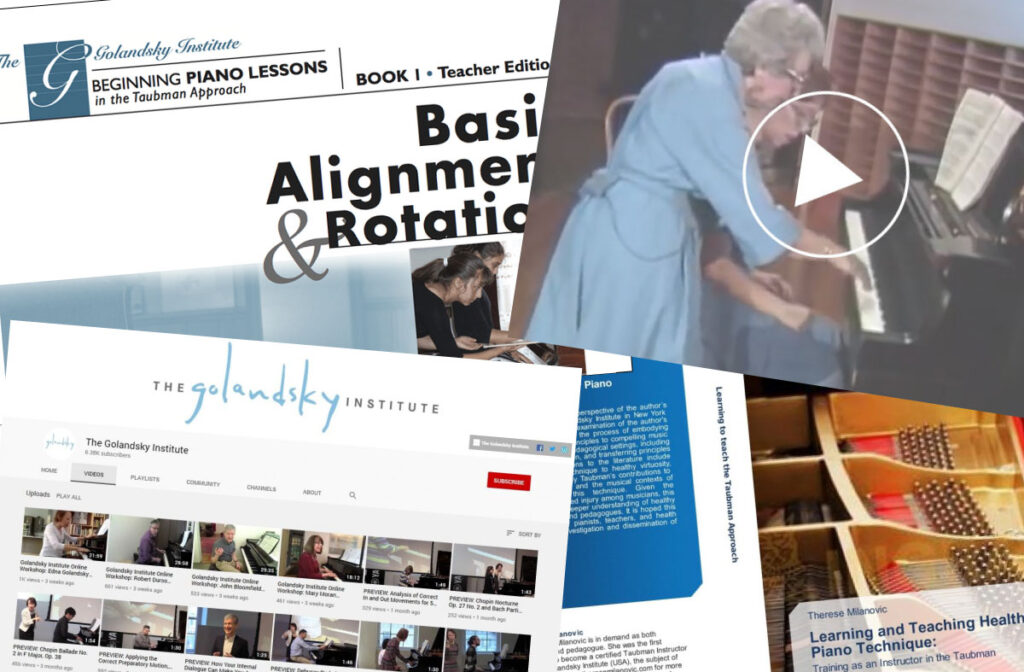
Articles, Videos, and Educational Materials
The pedagogy for the Taubman Approach involves more than learning how to apply the information to one’s own hands. An important initial observation is that we are all built the same — the same bones, muscles, ligaments and nervous system. In addition, the piano is governed by its own mechanical principles.
We do not, however, all end up with the same technical problems. For example, some people may come with a technique that involves too much relaxation, while others come with excessive tension. One person may have difficulties with a particular skill, while another person may find the same skill easy. In the first stages of learning, a person is given the information to help overcome problems related to his/her particular limitations. It is only after one has solved these technical problems and has internalized the information so that it begins to become automatic that one is ready to start teaching others.
Successful teaching demands that a teacher see the big picture, understand how to diagnose problems, implement solutions and know how to integrate the many various components of the technique and the music. It is also crucial to know how long to stay on a given track and when to move on.
The only way to develop the skills necessary to become an expert teacher is to learn by doing. For that reason, we have a system where each teacher can be mentored by taking his/her students to one of the teachers who has produced consistenly good results. The principles of the technique are logical and straight-forward, but the application is highly individual. A teacher needs to see many different problems in a variety of contexts in order to begin to develop true expertise.
The success of the mentoring approach has been dramatic. Once it was understood that the art of teaching could be taught, results became consistently better. Some people have more natural ability in this area than others; they identify problems more accurately and inculcate solutions more directly. However, we see over and over that with the right input from a more experienced teacher, most teachers can develop their own pedagogical skills to a much higher level.
The proof of this is in the results of the teaching. Students are learning faster and more thoroughly than ever before. With the right information from a teacher, skills can develop more predictably.
In a real sense, all teachers of the Taubman Approach are students too. We never stop refining our skills. The principles of the technique are clear, but we are constantly developing more insightful ways to describe them and help others understand them inside their own bodies. By having teachers with the most experience be available to help those who want to become experts, there is a way to nourish and train teachers at every level.
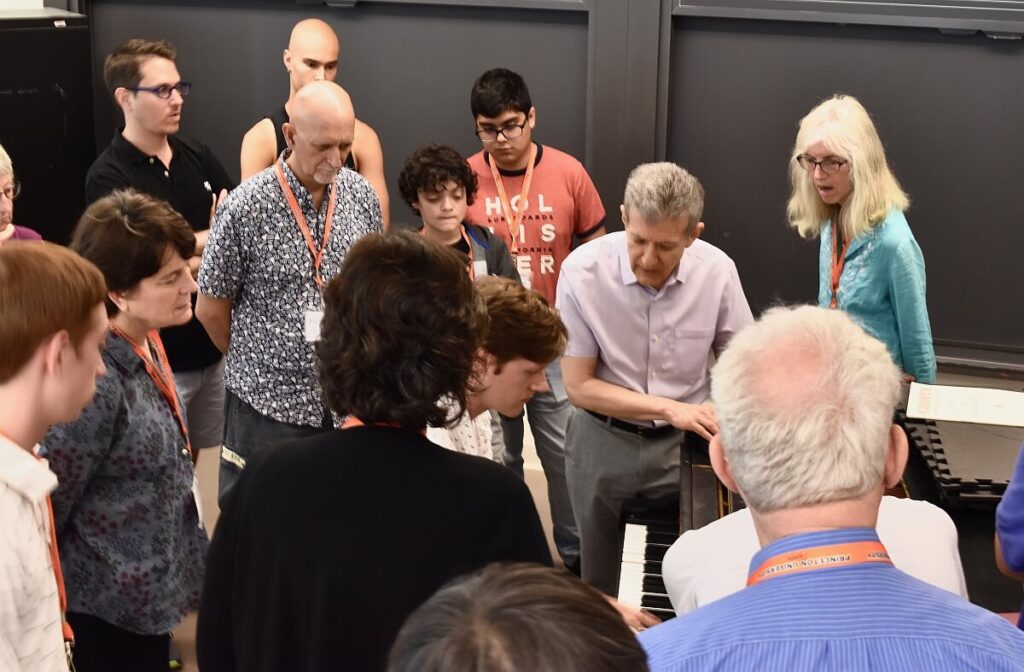
The teacher training Workshops are one of the mainstays of the mentoring system. The workshops take place several times a year in New York City, Philadelphia, and Berkeley. We teach students of our most experienced students in front of the group, and these students, in turn, teach the students of other teachers who are trying to boost the level of their own teaching. In addition, we present new developments and insights that facilitate the learning and teaching of the Taubman Approach.
The collaborative approach has proven beneficial to students and teachers alike. It might be thought that a naturally competitive spirit would undermine the process, but on the contrary, a sense of collegiality and community support has been the result. Every teacher knows that there is help around the corner if he/she comes to an impasse with a student. In fact, the only mistake a teacher can really make in the mentoring system is not to ask for help, which is the very thing that stops progress.
We are always happy to recommend experienced teachers for those looking for help on any level, whether it is to solve occasional passage problems, to address greater limitations, to correct serious problems, to improve in general or to gain greater insight into the Taubman Approach.
Many people exposed to the Taubman Approach have become excited by its possibilities and present themselves as Taubman teachers. They sometimes use the Taubman name in their biographical information and in the promotion of their workshops. While some may be gifted musicians, their results can be poor when they try to implement Taubman work without being thoroughly trained. In some cases, the results have been detrimental to the students.
Occasionally, teachers with this type of limited background combine Taubman concepts with other pedagogical approaches and different types of body work. These may bear a superficial resemblance to Taubman work, but they are not recommended by the Golandsky Institute, because they fundamentally alter the nature of the Taubman Approach.
The pedagogy of the Taubman Approach is highly specialized. Currently, successful instructors have rigorous, on-going training in order to be able to diagnose and solve problems effectively.
The Institute will be happy to recommend qualified teachers or clinicians, as well as to offer an assessment of anyone who claims to be teaching the Taubman Approach.
Decades ago, Dorothy Taubman’s genius led her to analyze what underlies virtuoso piano playing. The result of that investigation has produced a body of knowledge that can lead to an effortless and brilliant technique. It can also prevent and cure fatigue, pain and other playing-related injuries.
The Taubman Approach is a groundbreaking analysis of the mostly invisible motions that function underneath a virtuoso technique. The resulting knowledge makes it possible to help pianists overcome technical limitations as well as cure playing-related injuries. It is also the way that tone production and other components of expressive playing can be understood and taught.
Edna Golandsky is the person with whom Dorothy Taubman worked most closely. In 1976 Ms. Golandsky conceived the idea of establishing an Institute where people could come together during the summer and pursue an intensive investigation of the Taubman Approach. She encouraged Mrs. Taubman to establish the Taubman Institute, which they ran together as co-founders. Mrs. Taubman was Executive Director and Ms. Golandsky served as Artistic Director. Almost from the beginning, Mrs. Taubman entrusted Ms. Golandsky with the planning and programming of the annual summer session. She gave daily lectures on the Taubman Approach and later conducted master classes as well. As the face of the Taubman Approach, Ms. Golandsky discusses each of its elements in a ten-volume video series.
Mrs. Taubman has written, “I consider her the leading authority on the Taubman Approach to instrumental playing.“